
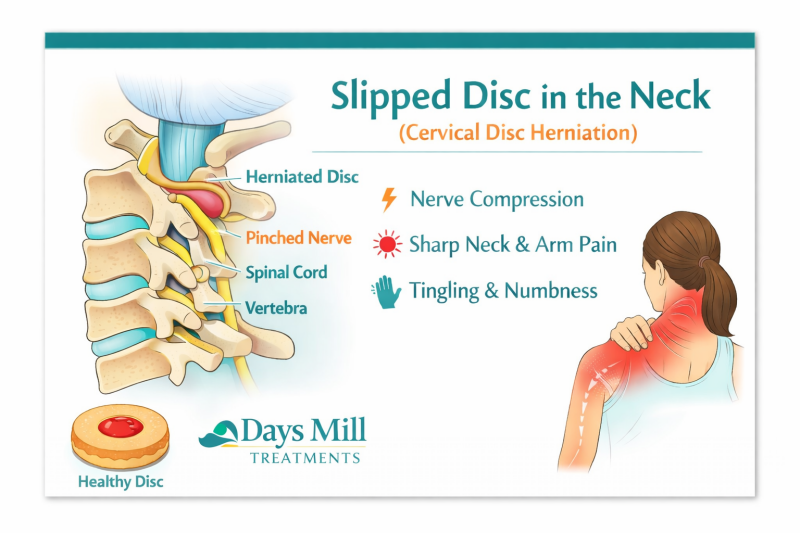
Cervical Disc Issues (“Slipped Disc”) – What You Need to Know
Cervical disc issues — often called a “slipped” or herniated disc — are a common cause of neck pain that can travel into the shoulder, arm, or hand.
Between each vertebra in your neck sits a disc made up of a soft centre (like jam in a doughnut) and a tougher outer ring. When the outer layer weakens or tears, the inner material can press on nearby nerves, leading to pain and neurological symptoms.
Common Symptoms
- Sharp, shooting pain in the neck, shoulder, or down one arm
- Tingling, numbness, or weakness in the arm or hand
- Headaches linked to neck tension
- Pain reproduced with movement
Symptoms are usually one-sided. Pain in both arms should always be taken seriously.
The Important Truth About Disc Injuries
Research shows there is no direct link between the size of a disc bulge and pain levels.
Many people have disc changes without any pain at all.
In fact, most cases improve significantly within 4–6 weeks, as:
- The disc settles and reduces pressure on nerves
- The nervous system becomes less sensitised
Ongoing pain is often driven not just by the disc itself, but by:
- Muscle tension and guarding
- Fascial restriction
- Trigger points
- Nervous system sensitivity
How Massage Can Help
At Days Mill Treatments, I use Jing Method™ clinical massage to address the surrounding structures contributing to your pain.
Treatment focuses on:
- Releasing tension in key muscles (upper trapezius, levator scapulae, SCM, scalenes)
- Reducing fascial tightness and trigger points
- Supporting safe, gradual return to movement
- Helping calm the nervous system
Importantly — massage does not “push a disc out” or make it worse.
Recovery: What Actually Helps
Recovery is not about complete rest — it’s about the right kind of movement.
- Gentle, pain-free movement helps recovery
- Gradually building activity restores confidence
- Positive understanding reduces fear and tension
- Self-care exercises support long-term improvement
The goal is to help you feel back in control of your body again.
🚩 When to Seek Medical Advice
While most cervical disc issues respond well to conservative care, seek medical advice if you experience:
- Pain, tingling, or weakness in both arms
- Progressive loss of strength or coordination
- Persistent or worsening numbness
- Loss of balance or difficulty walking
- Loss of bladder or bowel control
- Severe, unrelenting night pain
- Recent trauma (fall, accident)
These may indicate more serious involvement requiring medical assessment.
If neck pain or nerve symptoms are affecting your daily life, treatment can help you move better, reduce pain, and regain confidence.
👉 Book your session:
www.days-mill-treatments.co.uk
Calm. Clinical. Effective Pain Relief.
Add comment
Comments