
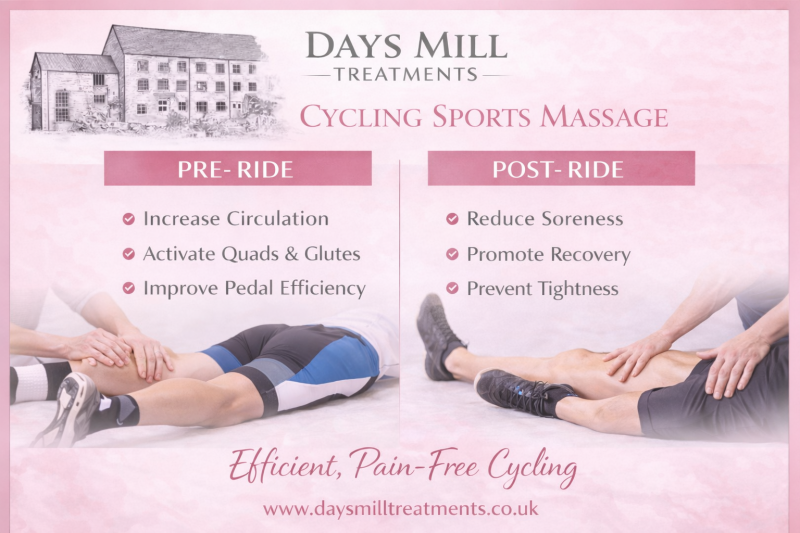
The Cyclist (Pre-Event) Sports Massage
Muscles a Sports Massage Therapist Would Massage for a Cyclist (Pre-Event)
1. Quadriceps (Rectus Femoris, Vastus Lateralis, Medialis, Intermedius)
Why:
Primary power generators during the downward phase of the pedal stroke.
Pre-event work reduces minor stiffness and improves activation without weakening force output.
Helps optimise cadence efficiency and climbing power.
2. Hamstrings (Biceps Femoris, Semitendinosus, Semimembranosus)
Why:
Assist in hip extension and help pull the pedal through the recovery phase.
Light pre-event massage improves mobility and reduces tightness that can restrict hip movement.
Supports smoother pedal mechanics and reduces strain on the lower back.
3. Gluteal Muscles (Gluteus Maximus, Medius, Minimus)
Why:
Glute max is a major power muscle for cycling, especially for climbing and sprinting.
Glute med/min stabilise the pelvis and prevent knee tracking issues.
Pre-event activation improves power transfer and reduces compensatory loading through the quads and hamstrings.
4. Hip Flexors (Iliopsoas, Rectus Femoris, Sartorius)
Why:
Heavily involved in lifting the pedal through the top of the stroke.
Often tight from long hours in a flexed cycling posture.
Gentle pre-event work improves hip mobility and prevents early fatigue or mechanical restriction during the race.
5. Calves (Gastrocnemius & Soleus)
Why:
Stabilise the ankle and contribute to pedal force efficiency.
Pre-event treatment helps maintain spring and responsiveness during high-cadence efforts.
Reduces stiffening in the lower leg, which is common after previous training sessions.
6. Tibialis Anterior & Shin Muscles
Why:
Important for ankle control and smooth pedal transitions.
Pre-event stimulation reduces risk of anterior shin tightness or fatigue early in the ride.
Helps maintain fluid dorsiflexion during the pedal cycle.
7. Lower Back (Lumbar Erectors, Quadratus Lumborum)
Why:
Cyclists hold a sustained forward-flexed posture, loading the lumbar spine for long periods.
Gentle pre-event work improves comfort, mobility, and breathing mechanics.
Helps prevent early onset of back tightness on the bike.
8. Upper Back & Shoulder Girdle
(Trapezius, Rhomboids, Deltoids, Serratus Anterior)
Why:
Stabilise the torso and handlebar control, especially during climbs and sprints.
Light pre-event massage reduces minor tension without over-softening these stabilising muscles.
Supports better posture on the bike and reduces hand/arm numbness during long rides.
9. Forearm Flexors & Extensors
Why:
Important for braking, gear shifting, and absorbing vibration through the handlebars.
Light stimulation helps improve grip and reduce fatigue in the hands and wrists.
Summary
A pre-event massage for a cyclist should focus on activation, mobility, and reducing minor stiffness—not deep relaxation.
Priority areas include:
✔ Quadriceps
✔ Hamstrings
✔ Glutes
✔ Hip flexors
✔ Calves & shin muscles
✔ Lower back
✔ Upper back & shoulders
✔ Forearms for handlebar control
These muscles support power output, cadence efficiency, joint mobility, stability, and comfort on the bike during competition or training.
Three Suitable Pre-Event Stretches For a Cyclist
1. Dynamic Hip Flexor & Quadriceps Mobilisation
Muscles stretched:
Hip flexors (iliopsoas)
Quadriceps (rectus femoris)
Type of stretch:
Dynamic stretching – gentle walking lunges with arm lift, or controlled leg swings backward.
Why suitable for cyclists:
Cyclists spend long periods in hip flexion. Dynamic mobilisation opens the front of the hip and improves pedal stroke efficiency without reducing muscular power.
2. Dynamic Hamstring & Glute Sweep
Muscles stretched:
Hamstrings
Gluteus maximus
Calves (gastrocnemius / soleus lightly engaged)
Type of stretch:
Dynamic sweeping stretch – controlled forward leg swings or “hamstring sweeps” touching the toe while moving.
Why suitable for cyclists:
Loosens the posterior chain, improves hip hinge mobility, and primes the legs for smooth rotation during the pedal cycle.
3. Dynamic Calf & Ankle Mobility Stretch
Muscles stretched:
Gastrocnemius
Soleus
Tibialis anterior (through active ankle dorsiflexion)
Type of stretch:
Dynamic calf raises with ankle mobility – slow rise-and-lower movements, forward ankle drives, or cycling motion mimics.
Why suitable for cyclists:
Activates and warms the calves and ankles, which are essential for force transfer through the pedal stroke and stabilising the foot on the bike.
Add comment
Comments