
Post Event Sports Massage
Ideally immediately after your event or within 24 hours. The best results come after your cool-down, with sessions lasting 10–30 minutes (around 20 minutes is ideal).
Pre-Event Sports Massage: Get Ready to Perform
Days Mill treatments in Nailsworth
Cervical Disc Issues (“Slipped Disc”) – What You Need to Know
Cervical Disc Issues (“Slipped Disc”) – What You Need to Know
Whiplash: What It Is & How Massage Can Help Recovery
Whiplash is a soft tissue neck injury caused by sudden forward and backward movement of the head — most commonly during car accidents, but also in sports or sudden impacts.
Headaches & Massage: How Jing Method™ Can Help
Headaches affect over 10 million people in the UK and are one of the most common reasons clients seek treatment. At Days Mill Treatments, we take a calm, clinical approach to understanding and reducing headache pain.
When Should I See a GP Instead of a Massage Therapist?
Nailsworth Clinical & sports massage can help many causes of back, neck and shoulder pain — but sometimes medical assessment is the right first step.
Frozen Shoulder or Just Tightness?
Frozen Shoulder or Muscle Tightness?
Why Do I Wake Up Stiff?
Morning Stiffness: Why It Happens
Is It Sciatica or Just Tight Muscles?
Pain in your lower back that travels into your hip or leg can feel worrying. Many people assume it’s sciatica — but that isn’t always the case.
What Is a Trigger Point?
Causes, Symptoms & Treatment in NailsworthIf you’re living with persistent shoulder pain, lower back pain, or tight muscles that keep returning, you may be dealing with a muscle trigger point.A trigger point is a small, sensitive knot within a tight band of muscle fibre. It’s essentially a contraction that hasn’t fully switched off. When pressed, it may:
Fascia Massage in Nailsworth: Why Tightness Isn’t Always a Muscle Problem
If you feel stiff all over, tight in the mornings, or like stretching only helps briefly, the issue may not be your muscles alone — it may be your fascia.
Why Old Injuries Still Cause Pain Years Later
Old Ankle Injury? Why Your Back or Hip May Hurt Years LaterIt’s common to hear:“I injured my ankle years ago, but it’s fine now… so why does my back keep hurting?”
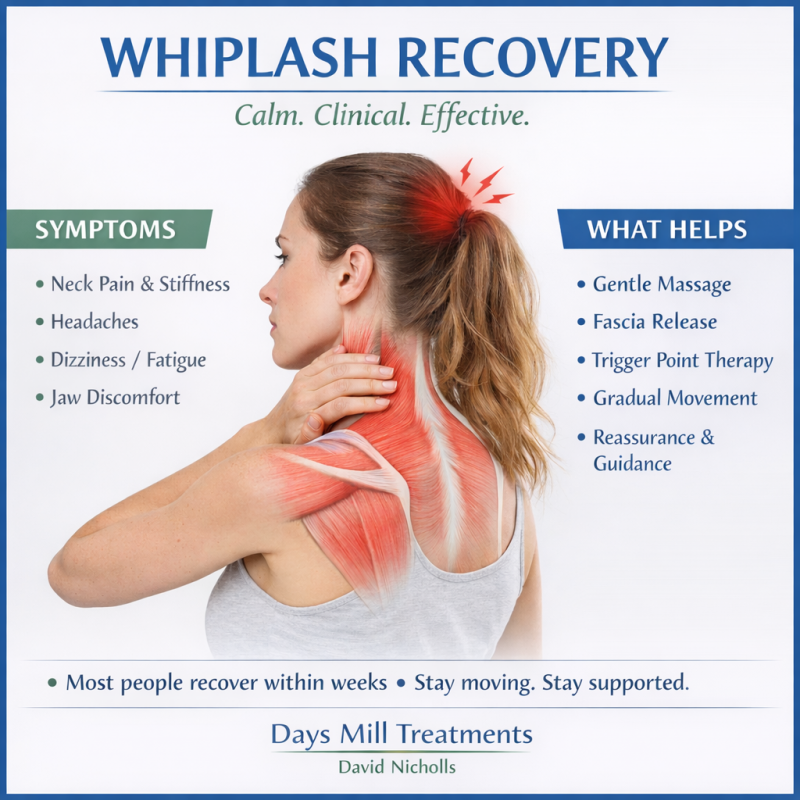
Whiplash is a soft tissue neck injury caused by sudden forward and backward movement of the head — most commonly during car accidents, but also in sports or sudden impacts.
What happens in whiplash?
This rapid movement can affect:
- Cervical muscles and fascia
- Ligaments and joints
- Nerve roots and discs
Key muscles often involved include the sternocleidomastoid, upper trapezius, levator scapulae, scalenes, and deep neck stabilisers.
Common symptoms
Symptoms don’t always appear immediately. Many people feel fine at first, with pain developing 24–48 hours later.
You may experience:
- Neck pain and stiffness
- Headaches
- Reduced movement
- Muscle spasm
- Jaw discomfort (TMJ)
- Dizziness or fatigue
Good news: full recovery is common for most people within the first month!
Research shows:
- 25% recover within 1 week
- Most recover within 1 month
- Only a small percentage develop long-term symptoms
How massage can help
At Days Mill Treatments, we use a clinical, evidence-informed approach to support recovery:
- Gentle soft tissue work to reduce muscle guarding
- Fascial release to restore movement
- Trigger point therapy to ease referred pain
- Guided movement to rebuild confidence
Treatment focuses on working within a comfortable, pain-free range, gradually restoring mobility and control.
The role of reassurance
After whiplash, it’s normal to feel anxious about movement. But recovery improves when you:
- Stay gently active
- Avoid prolonged rest
- Build movement gradually
- Understand that serious injury is rare
Persistent symptoms (WAD) are often linked to the nervous system staying in a protective state — not ongoing tissue damage.
When to seek help
If your symptoms aren’t improving, or you’re unsure what’s safe to do, professional support can help guide your recovery safely and effectively.
Book your treatment today:
👉 https://www.days-mill-treatments.co.uk
Calm. Clinical. Effective pain relief.
Add comment
Comments